
The curve that climbed, then bent.
Uma Huggins · June 24, 2026
Last verified June 2026 · figures computed on demand with design-based weighting.
The curve that climbed, then bent.
For six years the rate of drug overdose death in America rose almost without pause. In 2024 it fell harder than it had ever risen.
A rate is a quieter number than a count, and a more honest one. It asks not how many died but how common dying this way became — deaths per 100,000 people, adjusted so that an older population is not mistaken for a sicker one. By that measure the country went from 20.7 in 2018 to a peak of 32.6 in 2022: a level of overdose death with no precedent in the modern record.
Then the line did something it had not done in a decade. It turned down — slightly in 2023, and then, in 2024, it dropped to 23.1, the lowest figure since before the pandemic. This is the story of that shape: what drove it up, who it reached, and why the fall, though real, is not yet a recovery.
The epidemic became a fentanyl epidemic.
Pull the total apart by the type of drug involved and a single line dominates everything around it — synthetic opioids, overwhelmingly illicit fentanyl. Heroin, its predecessor, all but vanished from the record.
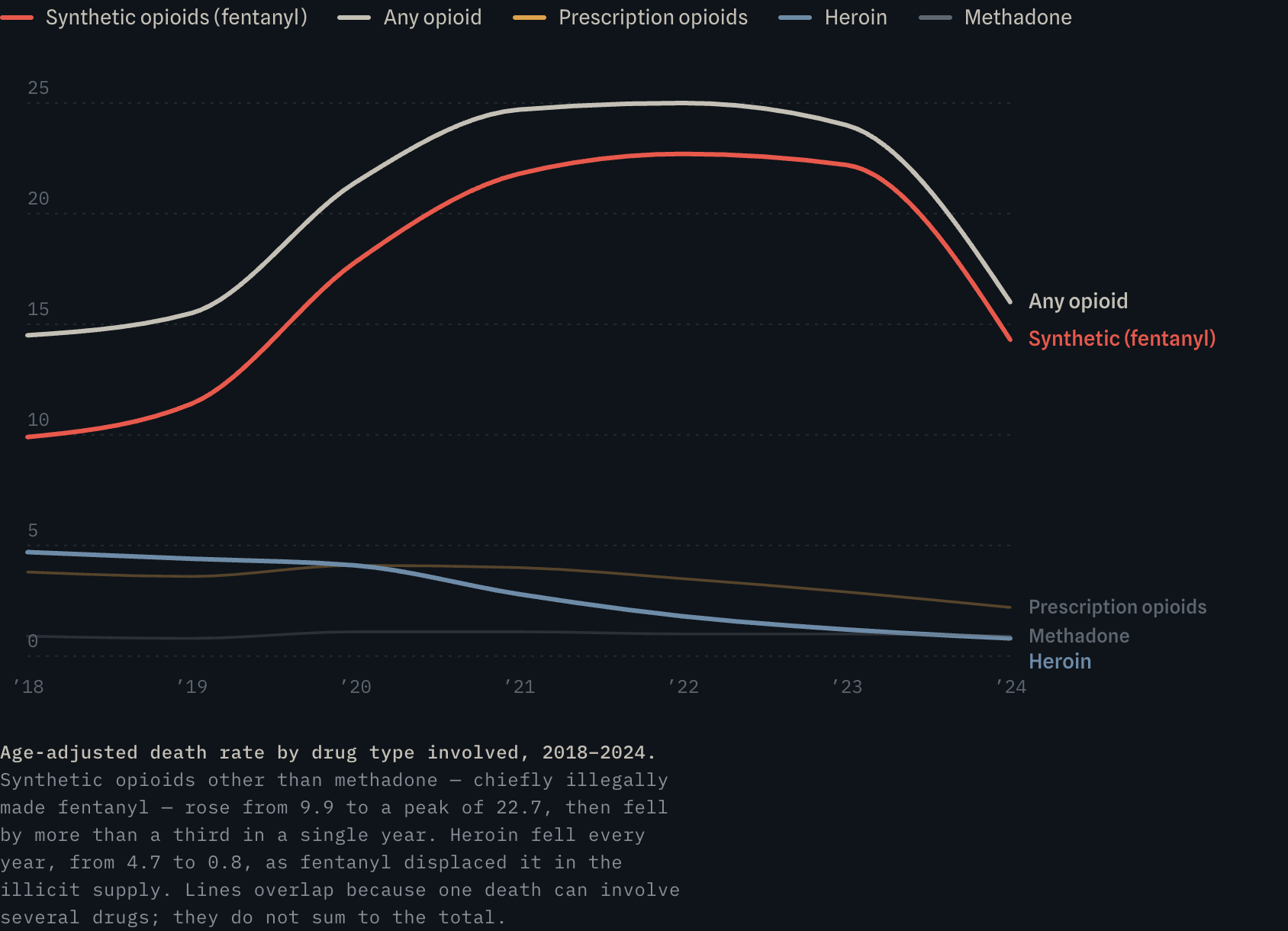
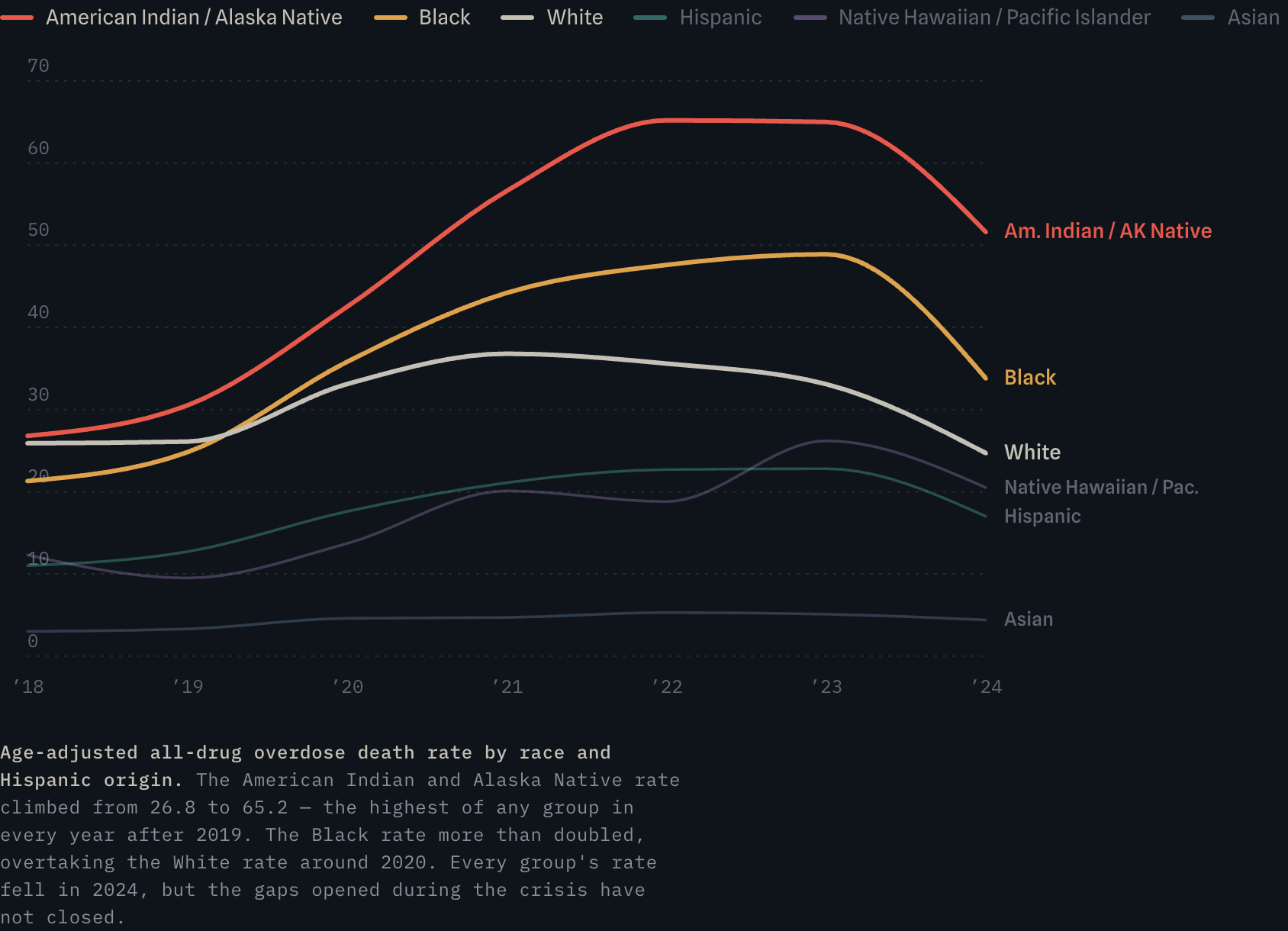
It stopped being a story about one group.
In 2018, White Americans had the highest age-adjusted overdose rate of any major group. Within a few years the burden had shifted — and by the peak years it fell hardest on American Indian and Alaska Native and on Black communities.
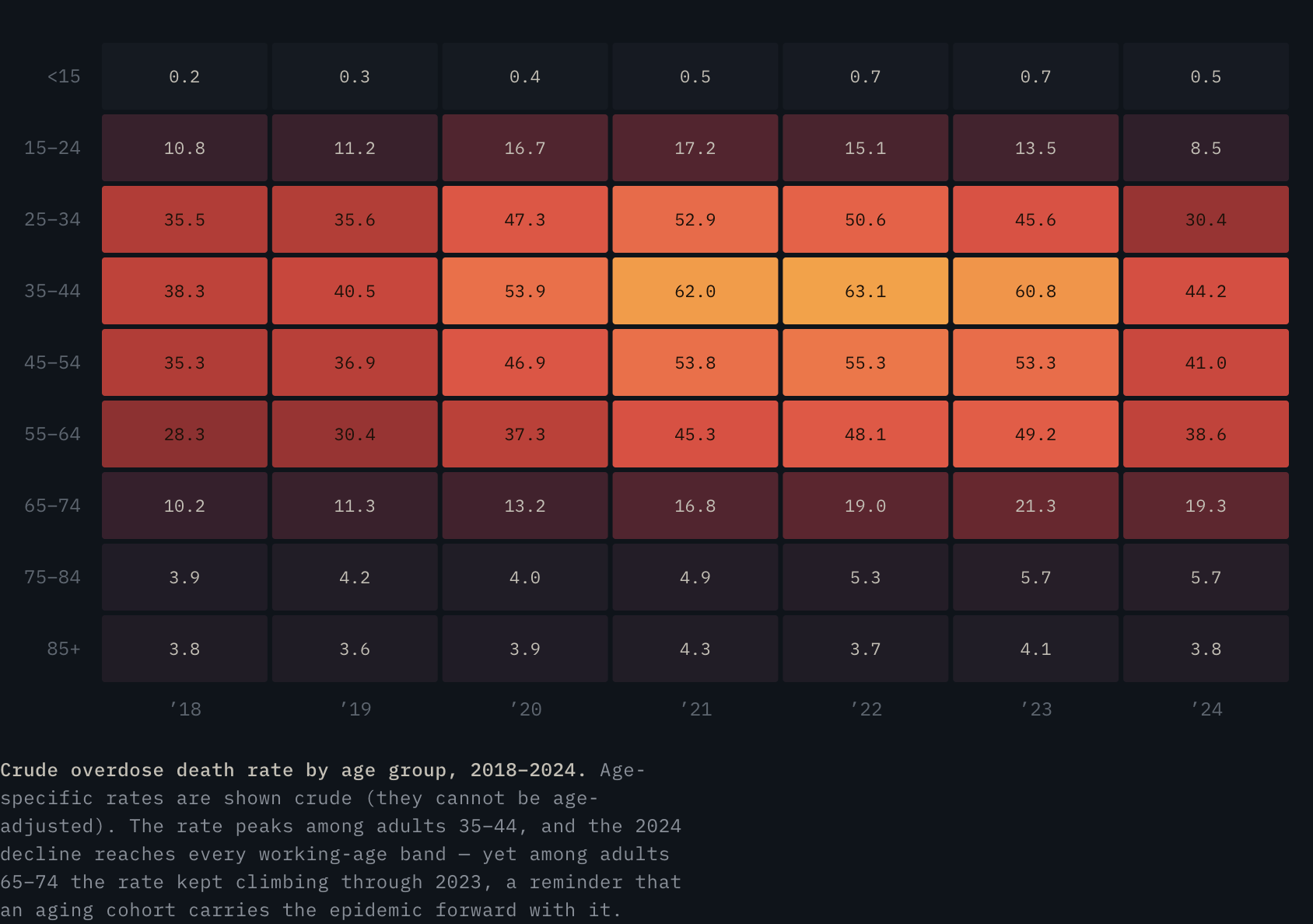
A crisis of the middle of life.
Overdose death is not spread evenly across a lifetime. It concentrates in working age — and within every age band, men die at roughly two to three times the rate of women.
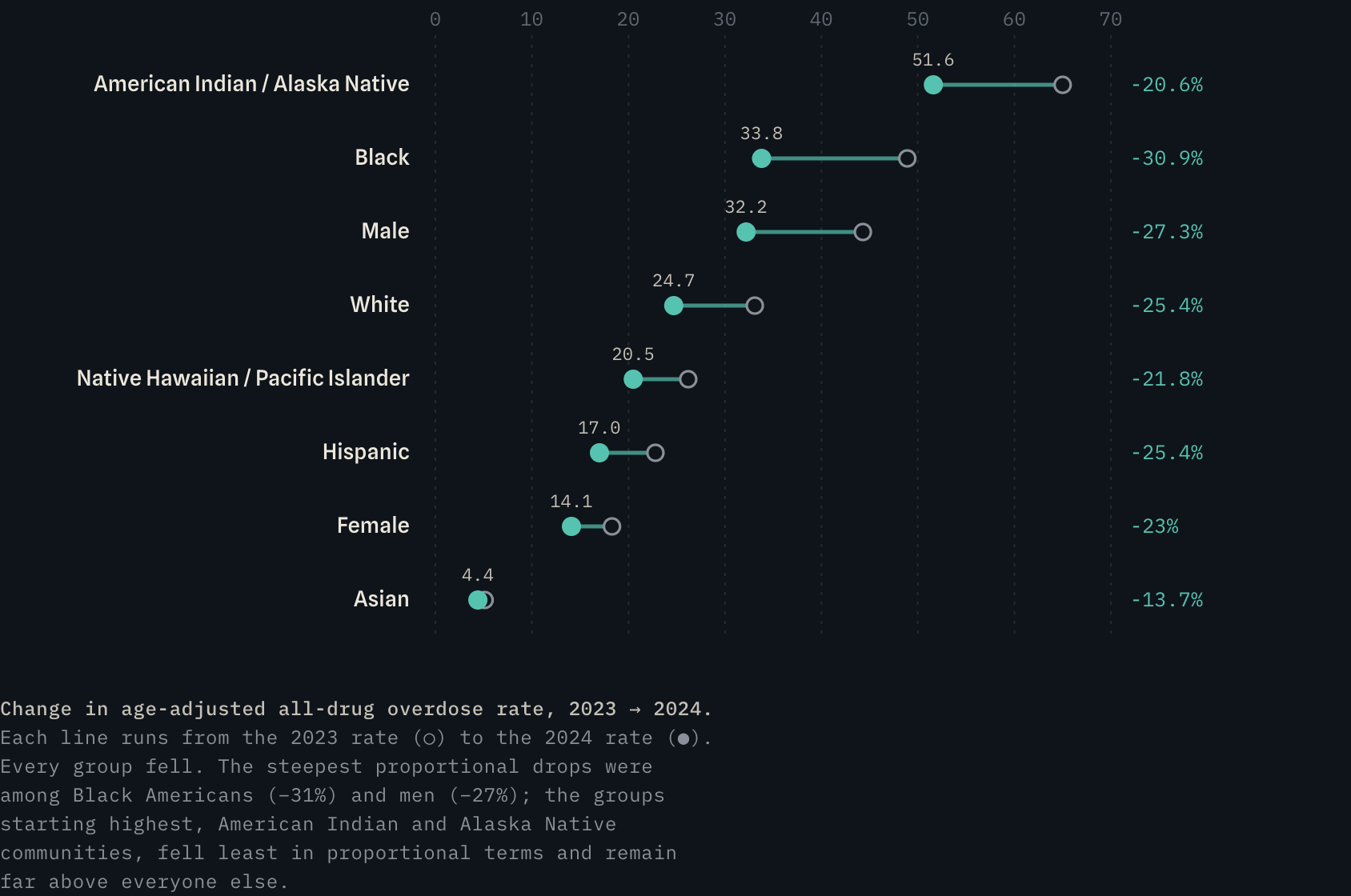
For once, it fell for everyone.
The remarkable thing about 2024 is not only that the rate dropped, but that it dropped across every group at once. No major demographic was left behind by the decline — though some had far more height to fall from.
A bent curve is not a closed chapter.
The 2024 decline is the largest the country has recorded, and it is broad and real. But the year still ended with an age-adjusted rate of 23.1 — higher than any year before 2020, and behind that rate stand tens of thousands of deaths. The line returned roughly to where it stood in 2019, the year before the pandemic; it did not return to safety.
Why it fell is genuinely uncertain. Researchers have offered several explanations — wider distribution of naloxone, better access to treatment, shifts in an illicit supply that may be saturating or changing — and none has been proven dominant. There is also a grimmer possibility that some of the decline reflects how many people at highest risk had already died. What the data here can show is the shape and the spread of the change. It cannot, on its own, tell us whether the curve will keep bending.
Source & method
National Center for Health Statistics, National Vital Statistics System, Mortality File — "Drug overdose death rates, by drug type, sex, age, race, and Hispanic origin," via CDC WONDER and the NCHS Data Query System. Estimates are deaths per 100,000 resident population; cross-group comparisons use age-adjusted rates, age-specific breakdowns use crude rates. Data last updated June 9, 2026; 2024 reflects finalized mortality data.
Reading notes
Rates, not counts.
Drug categories overlap; do not sum.
Suppressed and statistically unstable estimates in small subgroups are omitted from the charts.
"Synthetic opioids other than methadone" is chiefly illicit fentanyl and its analogs.
healthus@cdc.gov · cdc.gov/nchs/hus